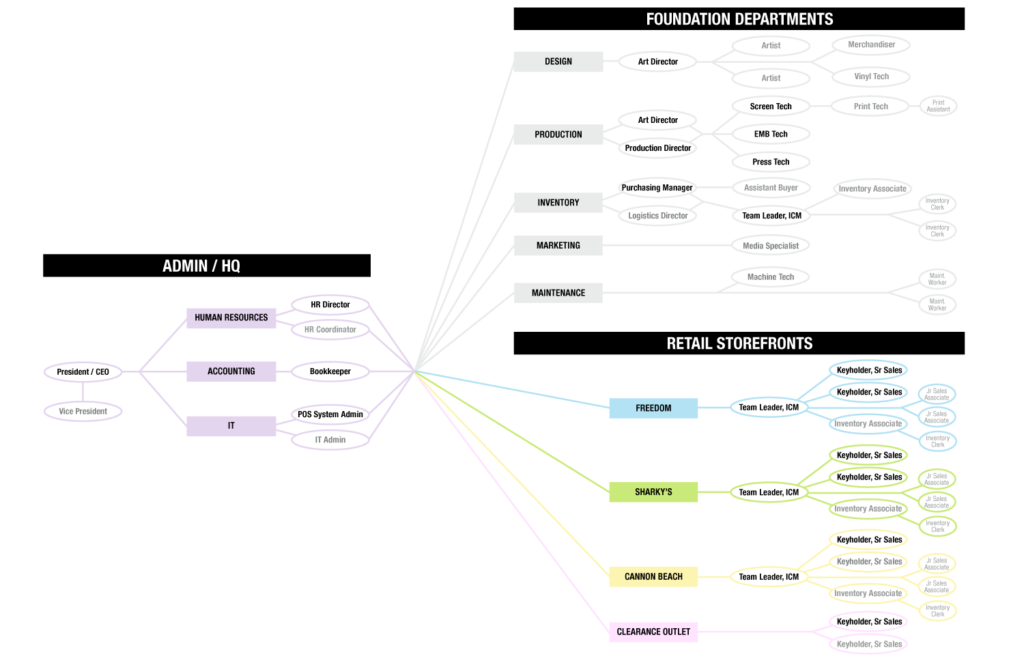
Category: 03. Roles & Responsibilities

03.1 Overview of Company Roles

Admin / HQ Roles

President / CEO:
Sets the course for the company by establishing the overall vision/goals and guiding key company policies and procedures. Oversees lead staff and makes important decisions that impact company identity, finances and growth.

Vice President:
Second in command, providing support & leadership by overseeing lead staff and stepping up as needed when the President / CEO is unavailable.

HR Director:
Responsible for overseeing company staffing needs including recruitment, training, scheduling, and disciplining to ensure employees follow all policies & procedures and the company operates in compliance with applicable laws. Monitors timekeeping records to ensure payroll accuracy, and develops plans & benefit programs to boost employee performance.

HR Coordinator:
Assists the HR Director by providing on-site support in the monitoring & training of staff to ensure adherence to company policies & procedures.

Bookkeeper:
Responsible for recording company financial accounts and records, including tracking invoices, transactions & payments and verifying records for accuracy.

POS System Admin:
Responsible for maintaining the POS item master, including new item creation, updates that facilitate maintaining appropriate inventory levels, and the running of reports to analyze sales and trends.

IT Admin:
Oversees proper functioning of hardware equipment and IT system functionality across all locations.

Retail / Storefront Roles

Team Leader, ICM (Retail):
Retail team leader (with ICM, Keyholder and Senior Sales Associate training & permissions) responsible for daily operations in a specific storefront location. Oversees all sales & inventory staff assigned to their location to ensure all operations are handled efficiently and in accordance with company policies.

Keyholder, Senior Sales Associate:
Experienced sales staff (with Senior Sales Associate training & permissions) proficient in all tasks related to opening and closing a specific storefront location.

Jr Sales Associate (seasonal):
Support staff able to assist with basic sales and printing.

Inventory Associate (retail):
Responsible for the routine tasks related to receiving and restocking in a specific retail location, including receiving transfers, checking in POs, and stock organization.

Inventory Clerk (retail, seasonal):
Responsible for the routine tasks related to organizing stock in a specific retail location, including folding, tagging, stickering and restocking items in their proper location.

Foundation Roles

Art Director:
Lead Artist responsible for the creation of designs, as well as directing other Artists & Production Staff in the creation & display of products for retail sale.

Artist:
Designer responsible for creating designs and establishing product combinations for retail sale. Proficient in the production of custom vinyl orders.

Vinyl Tech:
Proficient in the production of custom vinyl orders.

Merchandiser:
Responsible for the creation & maintenance of product displays, in accordance with guidelines of the Art Director and sales analysis/reports provided by the POS System Admin. Ensures new products are properly set up and displayed in each location, adequate inventory levels are being maintained, and that poor selling items are appropriately clearanced.

Production Director:
Works in conjunction with the Art Director to line up tasks related to the creation of products for retail & wholesale sale & ensure adequate stock levels are maintained.

Screen Tech:
Responsible for screenprinting pre-production tasks including file setup, film output, and coating & burning screens. Also proficient in all print production tasks (Print Technician).

Print Technician:
Proficient in tasks related to the production of transfer prints.

Print Assistant (seasonal):
Assists in basic tasks related to the production of transfer prints (e.g. “flapping” paper, powdering, etc).

Embroidery Tech:
Proficient in tasks related to the production of embroidered items.

Press Tech:
Proficient in tasks related to the production of WH preprints (and/or printed items for wholesale client orders).

Purchasing Manager:
Principal buyer responsible for ensuring Core & essential items are regularly reordered and adequate inventory levels are maintained at all locations.

Assistant Buyer:
Buyer responsible for reordering and maintaining adequate inventory of a specific grouping of items and/or items for a specific location.

Logistics Director:
Works in conjunction with the Purchasing Manager and oversees & directs warehouse operations to ensure stock is received and distributed appropriately.

Team Leader, ICM (WH):
Warehouse team leader (with ICM training & permissions) responsible for the proper execution of warehouse receiving & distribution operations. Oversees warehouse Inventory Associates & Inventory Clerks to ensure all operations are handled efficiently and according to schedule.

Inventory Associate (WH):
Responsible for the routine tasks related to warehouse receiving and distribution, including running reports, picking & sending transfers, checking in POs, and stock organization.

Inventory Clerk (WH, seasonal):
Responsible for routine tasks related to organizing warehouse stock, including folding, tagging, stickering, & stocking items in their proper location.

Machine Tech:
Responsible for the regular maintenance of equipment, as well as troubleshooting, diagnosis and repair.

Maintenance Worker (seasonal):
Staff responsible for “odd jobs” and/or the cleaning & maintenance of properties and workspaces.

03.2 Job Descriptions

Jr Sales Associate

An entry-level, often seasonal position, the Jr Sales Associate role provides retail sales support during the busy season. Customer needs are the primary focus of this role, and staff are responsible for providing attentive, friendly service, as well as pushing for high level sales.

Responsibilities:

Required skill guide proficiency:

Keyholder, Senior Sales Associate

Experienced Sales Associates demonstrating dependability and proficiency in all sales staff responsibilities, may graduate to the “Keyholder, Senior Sales Associate” role. Customer needs are still at the heart of this role, while including the added responsibilities of opening & closing the storefront location and ensuring store maintenance is performed regularly.

Responsibilities:

Required skill guide proficiency:

Team Leader, ICM (Retail)

Keyholder Senior Sales Associates who demonstrate exceptional leadership skills, dependability, and proficiency in all senior sales staff responsibilities, may graduate to the “Team Leader, ICM (Retail)” role. Thoroughness, attention to detail, and a complete understanding of essential inventory tasks is required (this role requires an ICM, “Inventory Control Manager,” or higher permission level in the POS system). While basic sales associate tasks may at times be part of daily activities, Team Leaders are able to balance these tasks with the bigger picture – overseeing and leading the team as a whole and ensuring essential operations remain on track. Highly proficient Team Leaders will be periodically selected for expansion opportunities in new store locations.

Responsibilities:

Required skill guide proficiency:

03.3 Performance Requirements

CTSJ has performance requirements that must be met by all employees. Below is a list of performance expectations that are required by all CTSJ employees.

  • Show up ready to work each day for your assigned shift and be prepared to stay if you are still needed
    • Be Flexible. During On Season, you expect that you may have to stay later to complete all your tasks or to help out with busier days.
    • Be Dependable. You may be called in to cover a sick employee or to support an unexpectedly busy day. Being there for your team is key in being a successful CTSJ employee.
  • Maintaining a positive attitude from start to finish each day you are at work
  • Following procedures properly and accurately
    • Do not differ from procedures because you think your idea’s are better, skip a step because you deem it unnecessary, change pricing because you feel prices are unfair, etc
    • These procedures are designed the way they are for a reason and must be followed.
    • If you have new innovative ideas or see a change you can make in a procedure to provide a more effective outcome, share it with your manager. These ideas will be vetted and accepted if they are in the companies best interest.
  • Completing tasks in a timely manner.
    • Manage you time wisely. Prep for success by setting realistic goals.
    • Projects must be completed from start to finish. For larger projects, break the project into smaller achievable activities.
  • Continually refining and perfecting your skills to meet our standards.
    • Identify your strengths and weaknesses. Use this to your advantage to focus on areas where you can improve.
  • Always on task, avoiding distractions and time wasters
    • This includes completing tasks given to you by your manager in the time frames that are requested within reason or asking for a time extension if needed.
    • NO PHONES except for work related communication and emergencies.
    • Align family or friend interactions with your breaks and lunches, not on the clock.
  • Keeping mistakes to a minimum to avoid product loss.
    • Some cases product loss is unavoidable, but in most instances the employee was not following the procedures properly resulting in damaged or lost merchandise.
  • Actively engaging customers and promoting higher sales
  • Maintaining a high level of accuracy
    • This includes but is not limited to Lightspeed transactions, print placement, inventory counts, etc.
  • Go above and beyond
    • Sometimes its that extra push in customer service or task that really puts you above the bar in performance.

03.4 Assignment & Delegation

Assignments:

Employees typically will be assigned certain tasks that they are responsible for completing. These assignments are recurring tasks that should be done on a normal basis (ie. daily, weekly, after closing, etc.). You will be assigned these tasks by your manager. Completion of these tasks are your responsibility and must be completed in the times specified. During busy days, it may be necessary to come in early or stay later in order to complete these tasks. In situations where you are unable to complete the task (ie. family emergency or illness) it is your responsibility to report to a manager that you will be unable to complete the task for that day. A manager can then find someone to complete the task or reassign the task for a different time. Assignments that employees fail to complete can lead to serious and sometimes costly problems (ie. Equipment maintenance not being completed and equipment failing/breaking). Often a manager will set these assignments as a recurring task on the Deputy App to confirm that the task is getting done. In this case, make sure to mark the assigned task on Deputy as completed. Marking a task as completed when the assignment is still incomplete will result in disciplinary action.

Delegation:

Managers will often provide extra work on top of your current job description that needs to be completed. The manager typically gives you a time frame that day in which the task needs to be completed. A delegation can be a wide range of different tasks that is not in your general job description. These delegations must be completed in the requested time. You may request a time extension from your manager if unforeseen circumstances are preventing you from completing them in the allotted amount of time. Failing to complete these tasks will result in disciplinary action so ensure that you are managing you time wisely in order to complete these tasks.

Remember that your #1 goal as a Sales Associate is to work with the customer and gather as many high quality sales as possible. Delegated tasks will be completed around the slower times when you have no customers that you can sale to. If the manager needs the delegated task to be done right away, the manager will provide another sales associate to cover the sales floor so you can quickly complete the task and get back to sales or the next delegated task.

03.5 Working as a Team

In order for our sales associates and stores to perform at peak efficiency, it requires teamwork! When our stores get busy during the On season, you and your team will be communicating and working together in order to quickly complete sales transactions. Good communication is essential in order to work smoothly as a team. Always bring a positive attitude to work and towards your fellow co-workers. CTSJ is comprised of many different stores, all with their own merchandise and sale trends. There is nothing wrong with friendly competition between the other stores but understand we as CTSJ are all one big team so always be friendly and helpful to others regardless of what store they typically work in. It is also okay to engage in friendly competition between other co-workers at your own location, but remember to be respectful. If one of your fellow teammates does not share the same interest in friendly competition, respect their right to do so. As long as every one is respectful and helpful to each other, we will continue to be a strong and productive team!

03.6 Loss Prevention – updated 3/2/23

  • Loss prevention is a responsibility of every employee at CTSJ Inc.
  • Theft is a commonplace occurrence in retail shops such as ours, however the majority of losses are easily preventable
  • In many ways, the prevention of theft is equally as important as making sales
  • The most effective way to prevent theft is to be constantly interacting and speaking to customers, as would-be thieves are often deterred by too much attention
  • Employees are expected to always be aware of their surroundings and actively look for people who are acting suspicious

Dos and Don’ts to prevent loss:

DO: Greet every customer

A simple greeting to a potential shoplifter can deter them from stealing. People that go in unrecognized are much more likely to shoplift.

DO: Keep the store clean and organized

A messy, unorganized store makes it easier for shoplifters to steal

DO: Build Customer Rapport

Building relationships with customers makes them less likely to steal from our stores.

DO: Watch for loiters

Loiters are bad for business, and some that feel comfortable loitering in the same store are more likely to steal.

DO: Watch for suspicious behavior

Often potential shoplifters will be carrying large bags. They may also be wearing sunglasses inside the building, hats, and/or large sweatshirts.

Shoplifters often stay in the same section of the store for extended periods of time. They may continually check to see if you are looking at them.

DO: Keep your team spread out throughout the store

Having all employees behind the counter for example, is a poor decision. Theft is much easier when all employees are in one area and much more difficult when the store is covered.

DO: Be aware of distractions

Some shoplifters may be working in pairs or teams. Sometimes they may have someone there to distract you while they steal merchandise. Even during conversation with our customers, be aware of your surroundings and things happening in the store.

DO: Use language like “is there anything you need me to hold for you at the counter?”

If you notice unusual behavior, approach the customer and ask questions. Imply that you are aware the customer has shown interest in items and made potential selections, and are naturally expecting a purchase to follow. If the customer is acting unusual, be very forward with your attention – it is ok to potentially make them feel uncomfortable (innocent people typically won’t be made uncomfortable). You can also ask “is there anything you need to pay for before leaving?”

DO: Ask a suspicious customer to leave the store

If the customer is clearly acting suspicious, notify a team leader if available. Immediately interact with the customer and be preemptive in asking a suspicious customer to leave the store. Don’t wait for something to happen. Ask them to leave before something happens!

DO: Get a detailed description (and preferably a photo)

Take note of the potential shoplifter’s appearance including age, height, weight, hair color, eye color, clothing and any other distinguishing features. Also take note of any specific items they have in their possession. If you are able to do so safely, snap a photo of the person.

DO: Immediately notify the other stores

Notify our sister stores of any suspicious individuals so that they can be on the lookout. Provide a detailed description and send photo(s) if available.

DO: Check video surveillance

If you believe a theft may have taken place, immediately check the camera system. If the act was caught on camera, contact the police and provide them with the information.

DON’T: Assume only customers are capable of stealing

Even co-workers are capable of shoplifting from our stores. Report any theft or suspicious activity to Management.

DON’T: Profile customers

A common stereotype is that certain races and genders are more likely to steal. Studies have shown that many of these stereotypes are untrue. It’s essential to treat all shoppers with the same levels of trust, respect, and suspicion.

DON’T: Verbally accuse a potential shoplifter of stealing

Confrontation can be dangerous with certain types of shoplifters. Do not accuse them of stealing as this can be dangerous. They are not a shoplifter until they leave the building with the item.

DON’T: Physically confront or chase a potential shoplifter

Never get physical with a shoplifter or put yourself in harms way. Don’t pursue or chase a shoplifter.

Scenarios:

If you feel a customer is attempting to shoplift, walk up to them and begin to talk. Do not approach them and accuse them of stealing. Instead ask if they need help and bring up the context of the situation. Here is an example

Potential Shoplifter: *Suspicious individual picks up a hat after looking around the store and puts it in his bag*

You: *Approach customer* “Hello sir, I noticed you were using your bag to carry one of our hats. I can hold that hat for you at the register so you can continue to shop until you are ready to purchase it, it’s not a problem!”

In most cases, the shoplifter will realize they are caught and give you the product back. They may pretend to shop some more or attempt to steal another item, but typically they will leave once they know they are on your radar. Even if the individual wasn’t planning on shoplifting, placing items in bags prior to purchase is against our policy. There is also the risk that they forget to pay for it once they get to the counter.

Get a good description of the individual including snapping a photo of them with your phone discretely if possible. If the individual walks out the store with the items unpaid, he/she has now shoplifted.

When an individual is caught shoplifting:

  1. Report the theft to your team leader and/or Management. They may call the police (not 911 unless it’s an emergency). He/she will need a description of the person and the items that were stolen.
  2. Have a detailed description (preferably a picture) and provide this to your team leader/management.
  3. Notify our sister stores and provide the description/picture of the shoplifter(s) to prevent further loss.

Seaside Police (non-emergency line):
503-738-6311

Cannon Beach Police (non-emergency line):
503-436-2811